News

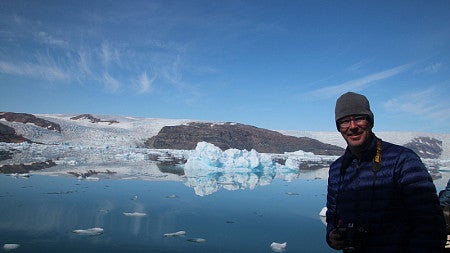
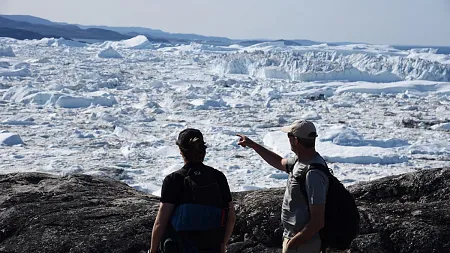
The Glacier Lab is a group of graduate students, CHC undergrads and postdocs who study the societal impacts of glaciers, icebergs and snow worldwide. Members of the lab come from diverse academic backgrounds, including environmental studies, anthropology, history and English.
In a state known for its inspiring landscapes — its beauty, how its residents both embrace and rely on it for sustenance — University of Oregon faculty, staff and students bring that same passion and fervor toward studying our environment and tackling the biggest challenges facing it.
Four interdisciplinary teams have been awarded seed funding through the Office of the Vice President for Research and Innovation to pursue interdisciplinary research projects. The Incubating Interdisciplinary Initiatives awards, known as I3 awards, will provide up to $50,000.
ENVIRONMENTAL STUDIES - During the tumultuous summer and fall of 2020, a photojournalist needed more than cameras and lenses to cover the news. Kevlar jackets, ballistic helmets, and gas masks were also standard operating equipment.
A University of Oregon program that provides education to incarcerated Oregonians is expanding with a boost from the Andrew W. Mellon Foundation, one of the largest supporters of the arts and humanities in the United States.
INFOGRAPHICS - In 2021, the University of Oregon has received a $4.52 million grant from The Andrew W. Mellon Foundation to support a new initiative envisioning a transformative research platform for racial and climate justice. It is the largest humanities award in UO history. As part of the funding, the Just Futures Institute includes cross campus collaboration.
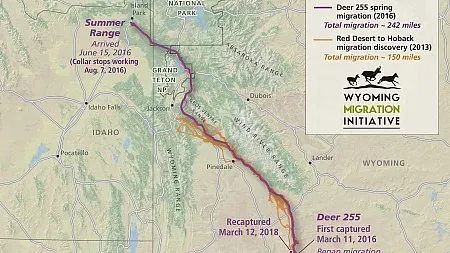
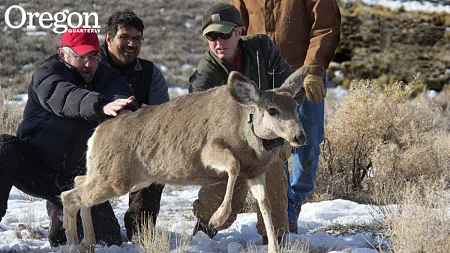
INFOGRAPHICS - A group out of the UO’s InfoGraphics Lab collaborated with Wyoming researchers, including biologist Matt Kauffman and filmmaker Gregory Nickerson, to produce a video that uses 3D visualization to show the doe’s accomplishment and track her most recent migration in the spring of 2019.
GEOGRAPHY, INFOGRAPHICS - Students are being trained in spatial data science are landing exciting jobs and serving humanitarian ends. The spatial data major draws from geography, computer science, and math to consider how location-based data and technologies can be leveraged across public policy, consumer technology, and disaster relief—to name a few of the discipline’s countless applications.
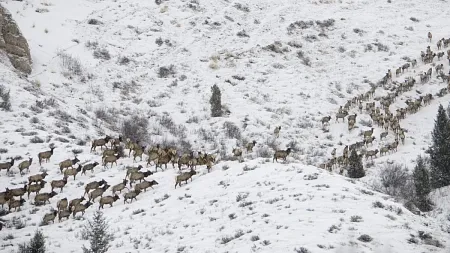
GEOGRAPHY, INFOGRAPHICS - Wild Migrations: Atlas of Wyoming’s Ungulates, published in 2018 by Oregon State University Press, documents deer journeys with words, photographs, and detailed maps.The project was led by tMatthew Kauffman, BS ’92 (biology), and Jim Meacham, BS ’84, MA ’92 (geography).
INFOGRAPHICS - A six-year collaboration between cartographers from the University of Oregon and wildlife biologists from the University of Wyoming has resulted in the publication this fall of “Wild Migrations: Atlas of Wyoming’s Ungulates.”
INFOGRAPHICS - Of the $21.1 million the NEH grant allocated in 2016, only two projects in Oregon earned an award. Of those two projects only UO’s Time Online received the maximum funding allowed. The project is an interactive history of infographic design, and it’s all about collaboration, according to its director and UO Robert D. Clark Honors College history professor Daniel Rosenberg.
INFOGRAPHICS - For two decades professor Esther Jacobson-Tepfer braved the challenging conditions in Mongolia’s rugged backcountry to catalog the country's monuments. For her work she was honored with the highest award by the Mongolian government. Her work was supported through a collaboration with UO geographer James Meacham and the UO’s InfoGraphics Lab.
INFOGRAPHICS - A video of migrating mule deer in western Wyoming making the rounds at various science news websites is breathtaking, as well as groundbreaking for a team of scientists that includes a group from the UO's InfoGraphics Lab.
INFOGRAPHICS - In 2014, University of Oregon’s then-first lady, Karol Gottfredson, worked on a project to label the trees around campus so that their stories can be appreciated. Infographics Lab has created a comprehensive “Atlas of Trees” and a brief, self-guided tour of the trees on campus is available through the UO’s mobile app so people can see the trees labeled like museum art pieces while walking through campus.