
A barrage of missiles struck Iran on February 28, 2026, and started a military conflict led by Israel and the US. As the region volleys back and forth from negotiations and military strikes, the rest of the world is dealing with the fallout from the conflict: a global economy now threatened by rising oil prices.
From gasoline to trash bags to crayons and cosmetics, oil and its byproducts are found in thousands of products, and they are crucial to the global economy.
Keaton Miller, an economics associate professor in the College of Arts and Sciences, specializes in industrial organization economics, studying interactions among private sector businesses, consumers and the government. The oil market is a global oligopoly, meaning that a small number of big producers control it, and Miller is well versed in navigating the market’s impact on global industry.
His view of oil’s current dynamics in the global economy is simple: "It’s a very classic principle of economics: supply and demand," Miller said.
Why global oil markets affect the US so much
When oil and gas prices go up, so do the prices of commodities, like wheat, corn and soy. For example, during Russia’s invasion of Ukraine in 2022, the cost of liquified natural gas (LNG) increased, as did the cost of wheat, corn and soy, leading to higher food costs in the US.
In the case of a commodity like corn, if oil prices rise, companies may turn to corn for ethanol as an alternative fuel source, which could have an impact on grocery prices.
“I put a graphic up in my Principles of Economics class that shows how oil prices and corn prices are highly correlated,” Miller said. “Good for Iowa farmers but bad for Safeway shoppers because corn goes into everything.”
High oil prices could also affect power utilities in US communities. Miller points to energy agencies in the Pacific Northwest, which is mostly powered by hydroelectricity from dams throughout the region.
As fossil fuel becomes more expensive, companies and industries may turn to hydroelectricity, leading to more competition and higher energy rates for everyday households.
“This is a pretty classic supply side, inflationary story of when energy prices go up that makes everything a little bit less efficient, a little bit more expensive,” Miller said.
Could the war lead to the same stagflation as in the 1970s?
Before Israel and the US attacked Iran on Feb. 28, oil prices were about $70 per barrel for Brent Crude oil from the North Sea — a trading classification for petroleum. Brent Crude is a pricing benchmark for about 80% of the global oil markets and is a health indicator of the global economy. Within the first month of the war, the price reached $122 per barrel on March 30, 2026, according to the US Federal Reserve Bank of St. Louis.
While some pundits have predicted the price per barrel could go as high as $200, Miller is skeptical about it getting that high. During the run up to the 2008 Great Recession, the highest oil prices went were $147 per barrel. Keaton expects that as oil prices get higher, oil companies will turn to alternative production techniques that aren’t profitable when oil is less than $100 a barrel but can make a difference when it’s more.
Miller is also optimistic that the conflict won’t lead to a global economic crisis like the events that led to 1970s stagflation, which was a mix of high inflation, stagnant economic growth and high unemployment rates. The 1970s economic downturn caused by massive supply shortages and quadrupled oil prices was amplified by two oil crises: 1) a 1973 oil embargo and 2) the 1979 Iranian Revolution.
Since the 1970s, the US Federal Reserve, the independent agency that serves as the country’s central banking system, has developed more monetary policy levers to ensure economic stability. Plus, the field of macroeconomics — the study of the economy as a whole — has developed over the past 50 years, and more knowledge is available to avoid the economic downturn that occurred in the 1970s.
How Iran’s control of the Strait of Hormuz affects gas prices
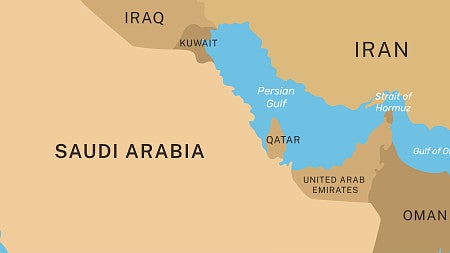
Iran ranks in the top 10 of the world’s oil producers, but the current conflict doesn’t just disrupt the country’s supply to the global oil market. It threatens access to the Strait of Hormuz, most of which runs along Iran and is controlled by Iran.
The strait is a narrow channel that connects oil-producing Persian Gulf countries to the global market. It’s a vital part of the global economy, connecting about 20% of the world’s oil, LNG and fertilizer to the market, according to a 2025 report from the U.S. Energy Information Administration.
“Up to this point, they’ve never really closed it,” Miller said. “And if less oil is going through those other countries, they are going to compete with us for oil on the international market, and that's going to push prices up.”
Even though the less than 10% of the oil that the US consumes is exported through the strait, the disruption hits home nevertheless, according to Miller.
"Oil is a globally priced commodity so a disruption anywhere affects prices everywhere," Miller said. "Even if the gasoline coming out of the pump here in Eugene came from oil pumped out of Alaska or the Gulf of Mexico, the price is determined in part as a function of the Brent Crude benchmark."
Can the US Strategic Petroleum Reserve help gas prices?
Of course, the cost at the gas pump is the biggest sign of the volatile price of global oil barrels, which can change daily.
The White House announced early in the Iran war that the federal government would release a historic amount of 172 million barrels of oil from the Strategic Petroleum Reserve, an emergency stockpile of crude oil. But the added oil barrels don’t immediately result in lower gas prices at the pump.
Oil released through this reserve is sold on the market, which means there’s no guarantee it will stay in the US. Although, Keaton said, the cost of transporting the oil outside the US could mean it’s likely the oil will stay domestically.
“There's a complicated calculus that oil traders are doing right now to forecast what's going to happen, and that's going to determine the extent to which the release of the reserve affects prices,” Miller said and adds that the longer the war goes on, the less impact the strategic reserve oil will have on prices.
The Iran war is in a mysterious place of resolution. It could end diplomatically. Or strikes could continue, and Iran could continue to use the Strait of Hormuz as leverage. There is the chance that this becomes another conflict like the Russia-Ukraine war that was expected to be over quickly and is now in its fourth year. And it could create tensions that lead to more fighting in countries that now face resource scarcities the longer the Strait of Hormuz is closed.
“We’re in this moment of uncertainty,” Miller said. “Markets are responding to the risk that this is a war that could last six months to a year. The way these conflicts reach a certain threshold of time, they end up lasting a lot longer.”
— By Henry Houston, College of Arts and Sciences