
The possibility of squatters taking over one’s home can spark nightmares for some homeowners. After a long vacation, could you return home and find that someone has changed the locks and taken over your property? And would you face a long road ahead for removing them legally?
That scenario is not usually how squatting happens, according to Claire Herbert, College of Arts of Sciences (CAS) sociology associate professor.
New research by Herbert and doctoral student Amanda Ricketts examined three US case studies where squatting was used as a tool to influence local and state decision makers. The two CAS sociologists published their findings in the article “Resisting and Reclaiming: Squatting as Contentious Urban Politics in the US” in the November 2025 issue of Social Problems.
With financial support from the University of Oregon’s Center for the Study of Women in Society, Herbert and Ricketts combed through news articles, legal decisions, city records, and interviewed activists to understand how advocates for housing insecure mothers in Detroit, Philadelphia and Oakland influenced policies through pro-squatting tactics. Looking at efforts by organizers to provide shelter for mothers is a way to look critically at the current housing market when so many people are experiencing homelessness, Herbert said.
What is squatting?
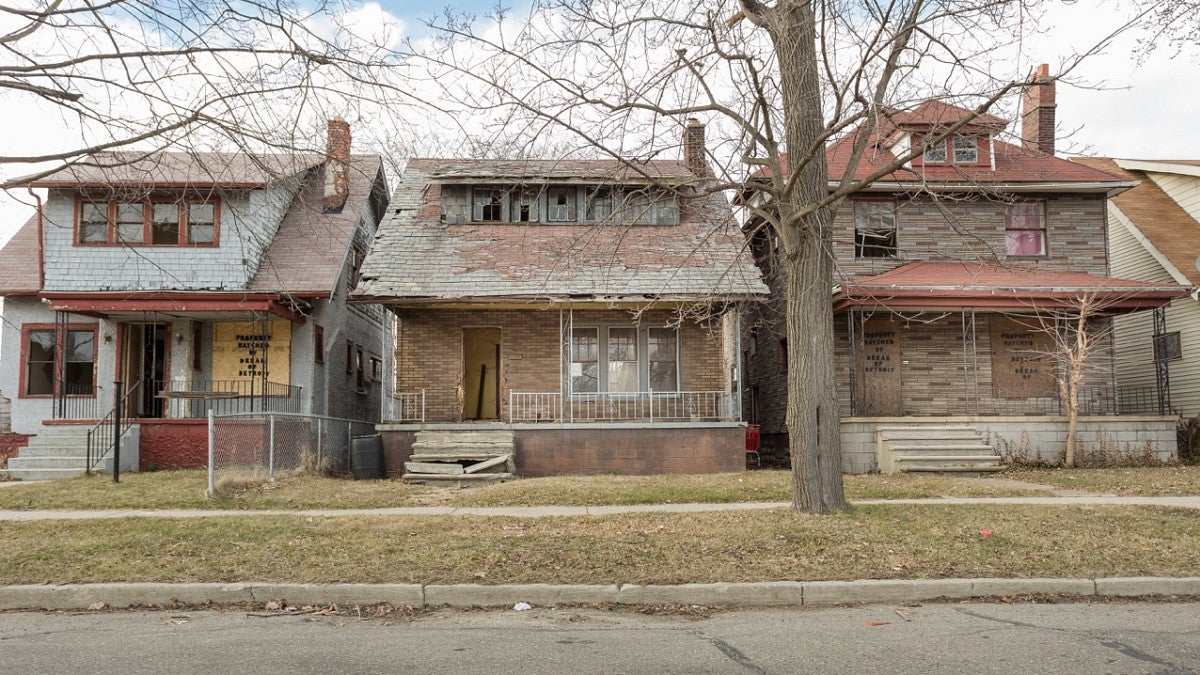
Squatting is the practice of someone, often someone living through housing insecurity, moving into a vacant home without permission or financial obligations. It’s technically trespassing, but that’s a crime that the property owner must report to law enforcement. Throughout Herbert’s research on housing, she said she found that in the US squatting overwhelmingly occurs in housing units that have been abandoned, neglected or left vacant for real estate market speculation.
“And in all those ways, the technical legal owners are not upholding the obligations of home ownership,” she said.
In cities with a high rate of empty houses and properties that aren’t maintained or regularly used, people turn to squatting, Herbert said. But when homes are maintained by the owners, squatters have less opportunity to move in and take over.
“Maybe we shouldn’t just blame squatters who need housing. We should consider the role of the property owners who are negligent, who are not caring for their property, who are not productively using it.”
How occupying vacant property can lead to policy change
In European countries and throughout the Global South, squatting has been used as a political action, as well as for basic shelter. Squatting for political reasons in the US is less common, Herbert said, but examples in Detroit, Philadelphia and Oakland revealed that squatting in vacant housing has led to policy changes.
During 2020 in Philadelphia, activists occupied land owned by the housing authority that was planned to become a mixed-use development, a path that could have led to the gentrification of a low-income neighborhood.
After experiencing a few months of squatting, the city agreed to activists' demands to use the vacant city-owned properties for permanent low-income housing.
Meanwhile, in Oakland, a group of Black mothers facing housing insecurity took over a vacant, corporate-owned house being held for future market speculation.
“The organizers took over the house,” Herbert said. “They were mothers. They had children. They could not find housing that they could afford, but Oakland was their home.”
Their eviction sparked such intense media coverage that a nonprofit eventually purchased the home for transitional housing, and the California Legislature passed Senate Bill 1079 to curb corporate sales of multiple foreclosed homes together.
And in Detroit, the 2008 Great Recession and the banking practices that led to the economic downturn battered the city’s already suffering housing market. Citing a 1980s era city ordinance intended to encourage homeownership if people transformed “nuisance” properties, advocates took over such properties.
But Detroit’s 2013 bankruptcy derailed the city’s willingness and financial ability to work with advocates.
“At a different time, they could have been more successful,” Herbert said.
What these squatting cases tell us about housing insecurity
In some US cities, houses don’t sit vacant for long without being purchased or rented. But what this research by Herbert and Ricketts shows is housing advocates can affect housing policies when housing units sit vacant for too long, whether due to government inefficiency or because investors keep them empty for market speculation.
“Different property market conditions contribute to the production of vacancy,” Herbert said. “These cases of squatting help diagnose those local problems and suggest alternative ways of using empty housing to benefit the broader community.”
—By Henry Houston, College of Arts and Sciences Communications