
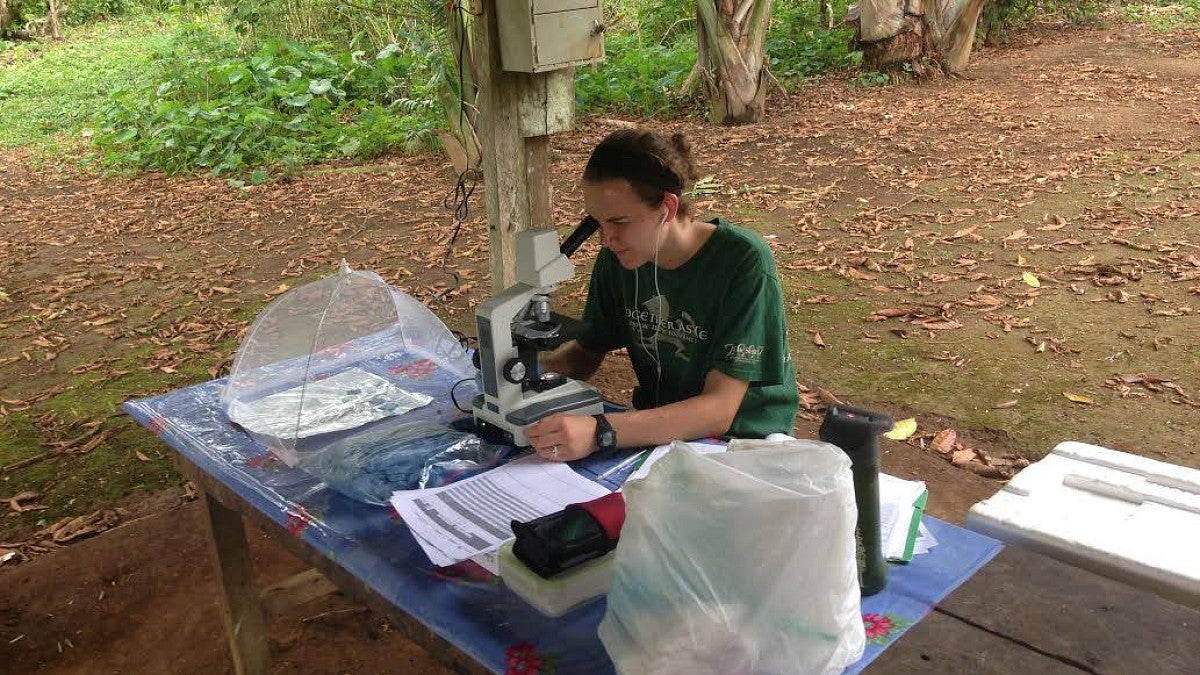
Theresa Gildner, PhD ’18 (anthropology), had several options for doctoral programs. But among the offers, she was drawn to the Department of Anthropology at the College of Arts and Sciences (CAS) because of its strong opportunities for fieldwork and the chance to publish impactful research under the mentorship of expert faculty.
As a CAS doctoral student, Gildner worked in the Shuar Health and Life History Project, a long-running collaboration with a South American Indigenous tribe in southeastern Ecuador founded by Anthropology Professor Larry Sugiyama.
“Most biomedical research is done in relatively wealthy, sedentary populations,” she said. “But that’s not how most humans have lived for the majority of our evolutionary history.”
Gildner’s work as a doctoral student led to publications and experience in conducting ethical field research that she continues as a faculty member at Washington University, whether she’s working on the Shuar Project or studying low-income regions of the southern US.
Studying testosterone in the Amazon
The ethics of care between anthropologists and research participants was a key reason Theresa Gildner felt CAS was the right fit for her. The Anthropology department’s emphasis on mentorship and interdisciplinary collaboration helped her grow as a researcher while staying grounded in the human dimensions of science.
Working under the mentorship of Professor Josh Snodgrass, Gildner concluded her research time working on the Shuar project with a study published in the American Journal of Human Biology, which examined testosterone changes in the Shuar Indigenous community of the Amazon. Their findings challenged the standard narrative on testosterone in high-income countries like the US.
In developed countries, studies show that adult male testosterone levels often decrease with age and are generally lower in individuals with higher body fat. Among adult male Shuar people, Gildner and researchers found that testosterone patterns still shift with age, but the direction and magnitude of testosterone changes depend on body composition.
“‘Normal’ hormone ranges are often treated as universal,” Gildner said. “But our results show that biology is responsive to environment. What’s typical in one setting may not be typical — or even healthy — in another.”
What Gildner found as a CAS doctoral student has an impact beyond anthropology. In the US and other developed countries, testosterone levels are increasingly medicalized with hormone replacement therapies. Gildner’s work adds to a body of evidence suggesting that variation in hormone levels can reflect adaptive responses to lifestyle and may not always require medical intervention.
Learning the ethics of fieldwork
While conducting fieldwork, Gildner learned from faculty members involved in the Shuar project about research ethics when working with vulnerable populations, such as the Shuar people.
They measured testosterone levels in the morning and evening across several days, capturing daily hormone rhythms and examined how they varied with age and body composition. This process required Gildner to collaborate closely with Shuar communities and cultivate mutual trust. The field experience she gained as a CAS doctoral student taught her that research is as much about relationships as it is about results.
“You can’t do this kind of work without trust,” she said. “It really changes how you think about your responsibility as a researcher.”
From the Amazon to Washington University
Her time at CAS and the valuable fieldwork experience with the Shuar people put her on the career path that now has her in a tenure-track faculty position at an R1 university. Shortly after graduation, Gildner was hired as a faculty member at Washington University in St. Louis, Missouri.
At Washington University, Gildner is expanding upon the research she did in the Shuar project and applying it in the US, focusing on communities of color. Applying the same life-history framework to understand how environment, health and social context shape human biology closer to home.
The move, she said, feels like a continuation rather than a departure.
“The foundation for how I think about research was built at Oregon,” Gildner said. “The questions I’m asking now grew directly out of the training and collaborations I had there.”
As her work continues to challenge one-size-fits-all models of human health, it also reflects the lasting impact of UO research, extending from Eugene to the Amazon, and now into communities across the US.
— By Maria Soto Cuesta, College of Arts and Sciences